GUIDE · SELF-BUNDED TANK CAPACITY
Safe Fill vs Gross Capacity: How to Size a Self-Bunded Tank
Clarify Safe Fill capacity versus gross volume, then use a simple sizing method so your RFQ matches the drawing — not a brochure litre that cannot be filled day to day.
WHO THIS IS FOR
Spec writers, ops and buyers who need an honest capacity line
This guide is for operations managers, spec writers and fleet, mining or construction buyers who need to size a self-bunded fuel tank before sending an RFQ. You will leave able to separate Safe Fill from gross (nominal) volume, run a transparent sizing method with labeled example maths, and fill a capacity checklist that engineering in Zhangjiagang can quote against.
Exact litres and Safe Fill for your order are confirmed on drawings and the written quote. This page is a method and a glossary — not a catalogue and not a price list.
DEFINITIONS
What “capacity” means on a self-bunded tank
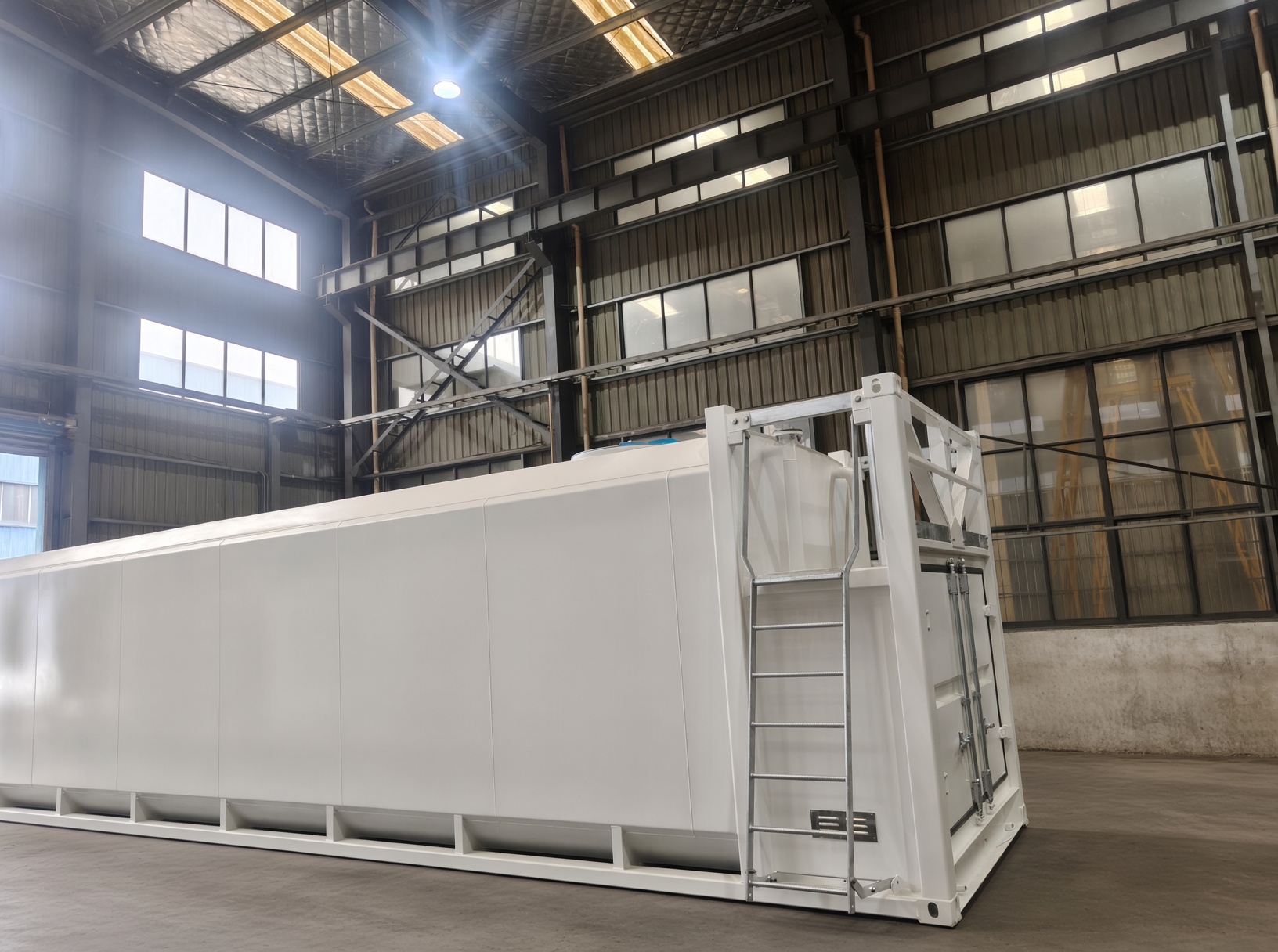
A self-bunded fuel tank (also called a double-wall or integrally bunded tank) is an above-ground steel unit: a primary vessel inside an integral outer steel bund, shipped and lifted as one piece. Full “what is” education lives on the product page; here we stay on capacity language.
Buyers often see one large litre figure on a brochure and assume that is usable fuel. That single-number habit is what this guide fixes. Self bunded tank capacity is not one number — it is at least gross geometry plus an agreed Safe Fill (working fill) for operations and quoting. The glossary table below is the language we use on drawings and RFQs.
GLOSSARY
Safe Fill vs gross (nominal) vs working capacity
Safe Fill is not gross volume. Gross (or nominal) volume is the full geometric capacity of the primary tank. Safe Fill capacity is the agreed working fill for day-to-day use and commercial quotes — typically below gross to leave vapour space, respect overfill practice and follow site rules. Working capacity, in plain English, is the fuel the site can actually draw under that agreed Safe Fill and the pump / piping layout; it is not a second secret nameplate. Always tie working capacity back to the Safe Fill on the quote.
Why the gap exists: vapour space, overfill protection practice, baffles, fittings, and destination rules. On every RFQ line, state whether your litre number is Safe Fill or gross.
| Term | Meaning | Use it for | Do not confuse with |
|---|---|---|---|
| Gross / nominal volume | Full geometric capacity of the primary (inner) tank. | Comparing shell size / nameplate geometry. | Day-to-day usable fuel. |
| Safe Fill | Agreed working fill for operations and quoting (typically below gross). | Pump sizing, commercial quotes, RFQ capacity line. | Gross volume. |
| Working capacity | Fuel the site can actually draw under the agreed Safe Fill and equipment layout. | Operations planning. | A second “secret” nameplate — always tie back to Safe Fill on the quote. |
| Family capacity range (200–130,000 L) | Span of tanks ZHONGBAO can build as a product family. | Understanding manufacturer scope. | A Safe Fill promise for any one tank. |
| ~38 kL / ~20 ft class | Common compact export footprint. Current drawing example (diesel): Gross 37,250 L / Safe Fill 35,340 L (95% on that drawing); outer 6058 × 2438 × 2896 mm. Litres for an order are confirmed on that order’s drawing / quotation. | Site layout and RFQ class selection. | A guarantee that every future order matches this example config. |
| ~68 kL / 40HC class | Flagship ~40 ft class. Current drawing example (diesel, ~68 kL / 40HC): Gross 69,050 L / Safe Fill 65,750 L. That drawing’s designed-to notes include AS1940 / AS1692 as design basis on that drawing — not ZHONGBAO company-wide held certifications. Litres for an order are confirmed on that order’s drawing / quotation. | Large-site quotes; working fill when discussing ~68 kL / 40HC-class units. | “Full 70k/75k + dispenser in one 40ft HC.” |
FOOTPRINT VS USABLE VOLUME
Why a 40ft-class tank is not “full cube litres + dispenser”
Outer footprint (~40 ft / HC class) is not the same as “full cube litres + dispenser.” When a front equipment room is fitted for pumps, filters, meters or a dispenser, that compartment uses length that would otherwise be tank shell. Do not imply full 70k/75k plus dispenser in one 40ft HC.
Current drawing example configs (diesel; cite as examples — litres for an order are confirmed on that order’s drawing / quotation):
- ~20 ft / ~38 kL class: Gross 37,250 L / Safe Fill 35,340 L (stated as 95% on that drawing); outer size 6058 × 2438 × 2896 mm.
- ~68 kL / 40HC class: Gross 69,050 L / Safe Fill 65,750 L. The ~68 kL / 40HC Safe Fill 65,750 L is the confirmed working fill for that drawing — still not “full cube + dispenser.” Designed-to notes on that drawing include AS1940 / AS1692 as design basis on that drawing only, not as ZHONGBAO company-wide held certifications for all markets.
For pump-integrated layouts see integrated dispensing tanks. For tank-plus-canopy portable stations see containerized fuel stations. For ~40 ft / ~68 kL class specs, see the 40ft / 68KL self-bunded fuel tank page, or send a written RFQ.
METHOD
How to size a self-bunded tank
Treat the steps below as a planning method, not a calculator guarantee and not an auto-assigned ZHONGBAO SKU. Fuel tank sizing starts from your site’s consumption and logistics, then engineering confirms Safe Fill and gross on the drawing.
Step 1: Daily (or shift) fuel consumption
Sum the equipment that will draw from the tank — gensets, plant, fleet. Use the buyer’s own logs or OEM burn rates. Use your own project figure rather than a generic “typical site” number.
Step 2: Days between refill (or desired autonomy)
Decide how many days of stock you want before the next tanker or IBC delivery. Remote sites often want more autonomy; urban depots may refill more often. That choice drives what size self bunded tank you need more than brochure family maxima.
Step 3: Buffer for delays and peak days
Add a buffer factor (commonly in a 10–25% band) for delivery slip, weather or peak load. The percentage is a planning choice for the buyer, not a ZHONGBAO standard.
Step 4: Site and logistics constraints
Check footprint (can the yard take a ~20 ft vs ~40 ft class?), lifting, access roads, and local containment rules. Say whether you need a dispenser room (Y/N). Fuel type — diesel, petrol, Jet-A / aviation kerosene, AdBlue–DEF or other — affects fittings and sometimes compartmenting; name it on the RFQ. Destination rules decide whether extra civil containment is still required; the buyer confirms locally.
Worked example (illustrative only — not a product spec)
Example numbers are illustrative for teaching the method. They are not ZHONGBAO catalogue capacities, Safe Fill guarantees or a quote. They are separate from the current drawing example configs (37,250 / 35,340 L and 69,050 / 65,750 L) listed above.
- Site uses about 2,000 L/day of diesel (buyer’s estimate).
- Wants 10 days between bulk refill.
- Raw need: 2,000 × 10 = 20,000 L.
- Adds a 20% planning buffer → 24,000 L target Safe Fill (not gross).
- Site can accept a ~20 ft-class footprint or may need to step to a larger class — ask engineering; do not auto-assign a SKU from this example.
- If an on-tank dispenser room is also required, usable Safe Fill may be lower than a tank-only shell of the same outer length.
Close the loop: send Safe Fill target + footprint + dispenser Y/N to RFQ. Zhangjiagang engineering confirms gross and Safe Fill on the drawing for the order. Typical production lead time sits in a 4–8 week band and is confirmed per order — not a new guarantee on this page.
RFQ
What to put on the RFQ (checklist)
Request a written quotation. An engineer from Zhangjiagang will confirm Safe Fill / gross on the drawing for your order. No public price list.
- Fuel type (diesel / petrol / aviation kerosene / AdBlue–DEF / other — specify).
- Required capacity and whether the number is Safe Fill or gross / nominal.
- Estimated consumption per day (or per shift) — if known.
- Desired days between refill / autonomy.
- Need front equipment / dispenser room? Y / N (and what equipment: pump, meter, filter, dispenser…).
- Preferred footprint class if known (~20 ft / ~40 ft / cube / other) or max L × W × H.
- Site access / lifting constraints.
- Destination country (buyer confirms local containment and document rules — this page does not publish a global legal matrix).
- Document / certification scope to request in writing for the model and destination (not a claim of certificates already held).
- Project timeline / required delivery window (if known).
Contact ZHONGBAO to request a quote with the fields above. Email dingzitong@zjgszbxg.cn or WhatsApp +86 173 3709 8626.
PITFALLS
Common mistakes
- Treating the brochure family max (up to 130,000 L) as the Safe Fill for one unit — that band is manufacturer scope, not a Safe Fill promise.
- Ordering “40ft full volume” plus a front dispenser without accepting the volume trade-off — a current ~68 kL / 40HC drawing lists Gross 69,050 L / Safe Fill 65,750 L, not 70k/75k + dispenser in one 40ft HC.
- Mixing petrol and diesel rules without naming the fuel on the order.
- Assuming no extra civil bund is ever required — destination rules still apply.
FAQ
Common questions
Is Safe Fill the same as gross volume?
No. Gross (or nominal) volume is the full geometric capacity of the primary tank. Safe Fill is the agreed working fill used for operations and commercial quotes, typically below gross. Always state which figure you mean on an RFQ.
How do I size a self-bunded tank?
Estimate daily or shift fuel use from your own logs or OEM burn rates, multiply by the days of autonomy you want, add a planning buffer you choose (often 10–25%), then check footprint, access, fuel type and dispenser-room needs. Send the Safe Fill target for confirmation on the drawing — the method is not a catalogue guarantee.
Does a front equipment room change capacity?
Yes. A front room for pumps or a dispenser uses length that would otherwise be tank volume — do not assume full 70k/75k plus dispenser in one 40ft HC. A current ~68 kL / 40HC drawing example (diesel) lists Gross 69,050 L / Safe Fill 65,750 L; that Safe Fill is the confirmed working fill for that drawing, not “full cube + dispenser.” Litres for your order are confirmed on that order’s drawing / quotation.
What capacity should I put on an RFQ?
State the litre figure and whether it is Safe Fill or gross/nominal, plus fuel type, daily use and autonomy if known, dispenser Y/N, footprint class, site limits, destination, and the certification or document scope you want confirmed in writing for the model and destination. Current drawing examples you may reference in discussion: ~20 ft class Gross 37,250 L / Safe Fill 35,340 L; ~68 kL / 40HC Gross 69,050 L / Safe Fill 65,750 L — final figures still confirmed on your order’s drawing / quotation.